










Are you ready to test your brain and have some fun? Our collection of detective and mystery riddles is perfect for kids, teens, and adults alike. From easy riddles for beginners to tricky puzzles for seasoned detectives, these riddles will challenge your thinking, spark curiosity, and keep you guessing.
Whether you love solving crime-based mysteries, figuring out clever wordplay, or tackling brain-teasing challenges, this guide has something for everyone. Each riddle comes with an answer, so you can check your detective skills and learn along the way.
Get ready to sharpen your mind, enjoy some laughter, and dive into the thrilling world of mysteries!
🕵️ Detective Riddles with Answers
1. I speak without a mouth and hear without ears. I have nobody, but I come alive with wind.
Answer: An echo.
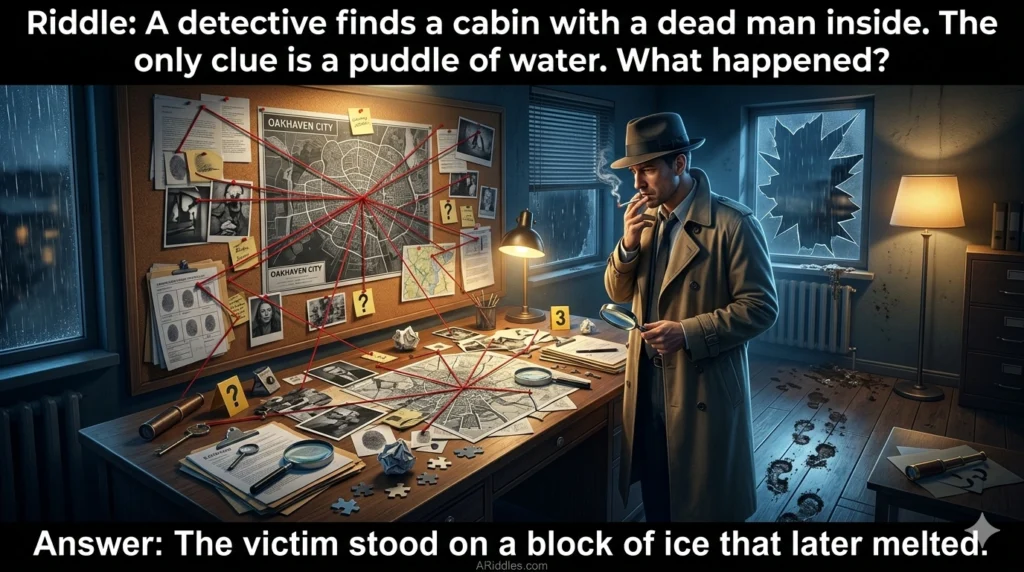
2. A man is found dead in a locked room with a puddle of water around him.
Answer: He stood on a block of ice, which melted.
3. A detective sees a man lying dead in the snow with a gun in his hand. There’s no snowball or footprints nearby. How did he die?
Answer: He shot himself in a plane crash; the snow is from high altitude.
4. A body is found with a note saying “I can’t breathe.” What’s the most likely cause of death?
Answer: Poison gas or suffocation.
5. Two men are found dead in a room. One is holding a knife, the other a rope. What happened?
Answer: They were playing a risky or staged scenario that led to their deaths.
6. A man is murdered on a Sunday morning. His wife calls the detective, claiming she wasn’t home. The detective quickly solved it. How?
Answer: The wife lied; her story didn’t match the evidence.
7. What disappears as soon as you say its name?
Answer: Silence.
8. A man is found dead in a field with a package next to him. The only clue is a parachute.
Answer: His parachute failed.
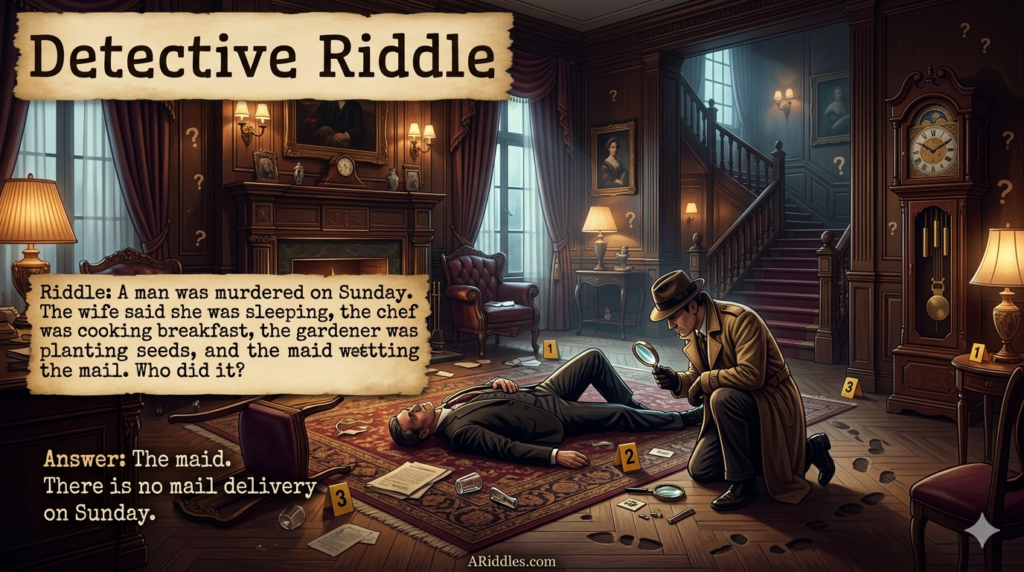
9. There are three houses: one made of straw, one of sticks, and one of bricks. Which house did the detective enter first?
Answer: The brick house.
10. A man is found dead in his car. There’s a puddle of water and no signs of violence.
Answer: He was in a situation involving melting ice or water.
11. A man walks into a bar and asks for a glass of water. The bartender points a gun at him. He says “Thank you” and leaves. Why?
Answer: He had hiccups; the scare cured them.
12. I am taken from a mine, shut in a wooden case, and used by almost every person.
Answer: Pencil lead (graphite).
13. A man is found hanging in his room. The room has no furniture, no chairs.
Answer: He stood on ice, which melted after.
14. A detective finds a crime scene with broken glass but no footprints. What likely happened?
Answer: The glass was broken from inside or no prints were left.
15. A man dies in a room that is completely sealed except for a small chimney. There’s no fire, no gas, no weapon. What happened?
Answer: He suffocated due to lack of air.
16. A man writes a note, “I know who did it,” then disappears. The detective sees footprints leading nowhere. Where did he go?
Answer: He escaped through a hidden exit or trapdoor.
17. A wealthy man is killed, and the detective finds a clue: “The answer lies in the painting.” What should the detective do?
Answer: Examine the painting for hidden clues.
18. A man is found dead in his study, and all doors are locked from inside. The windows are intact.
Answer: He was poisoned or killed by a hidden method.
19. A woman reports her husband missing. A week later, the detective finds him in the garden, perfectly alive, claiming he never left. How?
Answer: He was hiding or faking his disappearance.
20. A detective finds a man drowned in a bathtub filled with water and ice cubes. The water level is unusually low.
Answer: He stood on ice which melted, leading to drowning.
👥 Detective Riddles by Audience
21. A man enters a room and finds a diary open to today’s date. It says, “You will find the truth in the key.” What should he look for?
Answer: A hidden key or a clue attached to the diary.
22. A woman says she saw her neighbor leave at 9 AM, but the detective knows the neighbor was home. How did the detective know?
Answer: The clocks in the neighbor’s house stopped, or surveillance showed no one left.
23. Two people claim they were in the park all afternoon. The detective finds footprints leading to a nearby shop. Who’s lying?
Answer: The one whose footprints left the park.
24. A man is found with a wallet full of fake money. The detective checks the serial numbers and finds the real criminal. How?
Answer: The real criminal left a unique serial number among the fake notes.
25. A phone rings with no caller ID. The detective traces the call and finds the suspect’s location. How?
Answer: Using cell tower triangulation.
26. A woman reports her jewels stolen. The detective notices muddy footprints leading outside. What did she miss?
Answer: The thief entered through a window and walked across the garden.
27. Two suspects claim they never touched the safe. The detective notices fingerprints. Whose are they?
Answer: The fingerprints match one of the suspects, revealing the liar.
28. A delivery arrives with no sender’s name. The detective notices the stamp is from the same city as the victim. Why is this important?
Answer: The sender is local, narrowing down suspects.
29. A man claims he saw a thief at midnight. The detective checks the security cameras. The man is lying. How did he know?
Answer: The camera shows the man himself entering the house.
30. A person receives an anonymous note warning them of danger. The detective finds a clue in the handwriting. What is it?
Answer: The handwriting matches someone familiar to the victim.
31. A neighbor reports loud noises at 2 AM, but everyone claims they were asleep. What could explain this?
Answer: It was a prank or a mechanical source, like a broken pipe.
32. A man says his cat alerted him before a burglary. How could this help the detective?
Answer: The cat’s behavior gives a timeline of the break-in.
🧒 Detective Riddles for Kids
33. A cookie disappears from the kitchen. The detective sees crumbs on the floor. Who took it?
Answer: The pet or sibling who followed the crumbs.
34. A toy is missing from a child’s room. There are small footprints leading outside. Who might it be?
Answer: A pet or neighborhood animal.
35. Someone drew on the wall with crayons. The detective finds a box of crayons open. Who is the culprit?
Answer: The child with access to the crayons.
36. A child’s backpack is gone, but a trail of books leads to the playground. Where is it?
Answer: The backpack was left or taken to the playground.
37. A cookie jar is empty, and flour is on the floor. Who is likely responsible?
Answer: The child who baked or tried to sneak cookies.
38. A dog is barking at the fence. The detective notices footprints in the garden. Who or what is causing the commotion?
Answer: A neighbor’s pet or small animal.
39. A puzzle piece is missing from the table. The detective finds it under the sofa. Who moved it?
Answer: The child or pet who played nearby.
40. A book falls from a shelf, and the detective sees a trail of pencils. What happened?
Answer: A child accidentally knocked it over while playing.
41. Someone drew on the sidewalk with chalk. The detective notices chalk dust leading to the garage. Who did it?
Answer: The child who was playing outside.
42. A cookie has a bite taken out, but the plate is empty. Who could it be?
Answer: The child or pet with access to the cookies.
43. A ball rolls into the street. The detective sees a trail of footprints. Who chased it?
Answer: The child who lost the ball.
44. A drawer is open, and crayons are scattered. Who caused the mess?
Answer: The child who wanted to draw.
🎓 Detective Riddles for Students
45. A student finds a notebook on the floor with the last page missing. How can the detective find who took it?
Answer: Check handwriting, fingerprints, or ask classmates who were nearby.
46. During an exam, a student claims the answer key disappeared. The detective notices pencil marks on a desk. Who could be responsible?
Answer: The student who wrote notes or tried to cheat.
47. A library book is missing, but another copy is left on the shelf. How does the detective figure out the thief?
Answer: Compare borrower records or check surveillance footage.
48. Someone scribbled on the whiteboard after class. How can the detective find the culprit?
Answer: Check handwriting and who had access to markers.
49. A calculator is gone from a classroom. The detective finds scratch marks on the floor. What does this reveal?
Answer: The student who dropped it or moved it secretly.
50. During a school event, a trophy is stolen. How can the detective solve it?
Answer: Check who was near the trophy and who had a motive.
51. A student gets a note saying, “Meet me at lunch.” The detective finds the handwriting suspicious. How can they confirm?
Answer: Compare with other students’ handwriting samples.
52. Someone changed the classroom clock. How can the detective know who did it?
Answer: Ask who was last in the room and check fingerprints on the clock.
53. A laptop disappears from the computer lab. What’s the first clue the detective looks for?
Answer: Security camera footage or login activity.
54. A hall pass goes missing. How can the detective find the responsible student?
Answer: Trace who had it last or ask witnesses.
55. A test paper is torn into pieces. What can the detective do?
Answer: Reassemble the paper and question students who were present.
56. Someone left a chair in a hallway blocking the door. How can the detective find out who did it?
Answer: Ask students nearby or check fingerprints on the chair.
🧑 Detective Riddles for Adults
57. A man reports missing jewelry. The detective notices a muddy shoe print near the window. Who is likely responsible?
Answer: Someone who entered from outside.
58. A woman claims her car was stolen, but the detective sees it parked in a hidden spot. What happened?
Answer: She forgot where she parked or lied.
59. A man finds a strange note on his desk at work. How can the detective trace it?
Answer: Check handwriting, ink, and paper type.
60. Someone broke into a house but left no fingerprints. How did the detective solve it?
Answer: By checking footprints, tool marks, or surveillance cameras.
61. A wallet is found in a park. How can the detective find the owner?
Answer: Look for ID, bank cards, or contact information.
62. A man is poisoned at a dinner party. How does the detective identify the culprit?
Answer: Check food and drink traces and who handled them.
63. A package is delivered anonymously. How can the detective find the sender?
Answer: Check the postmark, handwriting, or delivery route.
64. A woman’s laptop is hacked. How can the detective find the hacker?
Answer: Trace IP addresses and login history.
65. A man’s safe is empty. How does the detective know who did it?
Answer: Check who had access and fingerprints on the safe.
66. A man disappears during a meeting. How does the detective locate him?
Answer: Check CCTV, phone GPS, or ask witnesses.
67. A car accident seems suspicious. How can the detective prove foul play?
Answer: Examine tire marks, vehicle damage, and eyewitness accounts.
68. Someone leaves a threatening email. How can the detective find the sender?
Answer: Trace the email header and IP address.
See also 160+ Riddles for Adults with Answers
🕵️♂️ Mystery Riddles with Answers
69. A man is found dead in a locked room with a puddle beneath him. How?
Answer: He stood on a block of ice, which melted.
70. A woman finds a note that says, “The truth is in the clock.” What should she check?
Answer: The hands of the clock or a hidden compartment.
71. A man disappears after leaving a message: “Follow the light.” What does it mean?
Answer: Check streetlights or signals in the area.
72. Someone leaves a trail of footprints in the sand, ending abruptly. What happened?
Answer: They walked into water or climbed a hidden object.
73. A diary shows dates missing. What should the detective do?
Answer: Check for torn pages or hidden notes.
74. A painting is tilted on the wall, hiding a keyhole. How does the detective notice it?
Answer: Check alignment and marks behind the painting.
75. A man receives a coded message. How can the detective decode it?
Answer: Use pattern recognition or a cipher key.
76. A door opens on its own in a locked house. Why?
Answer: A hidden mechanism or secret latch is used.
77. A man is found unconscious with a spilled cup. What clue is critical?
Answer: The contents of the cup or fingerprints.
78. Someone leaves a strange object in the mailbox. What should the detective do?
Answer: Examine the object for fingerprints, notes, or hidden compartments.
79. A man is found with a torn map. How does the detective solve the mystery?
Answer: Reassemble the map and follow the marked trail.
80. A note says, “I was never here.” How does the detective know if it’s a lie?
Answer: Check fingerprints, handwriting, or witness accounts.
✂️ Short Mystery Riddles with Answers
81. A coin disappears from a table. Who took it?
Answer: The person with access and fingerprints on the coin.
82. A key is missing, but the lock is untouched. How?
Answer: It was hidden nearby.
83. A window is open, but no one entered. Why?
Answer: The wind or an automatic mechanism.
84. A chair is overturned. Who did it?
Answer: The last person in the room or a pet.
85. A watch stops at 3 PM. Why?
Answer: The battery died or it was tampered with.
86. A drawer is open, but nothing is missing. Why?
Answer: Someone searched but took nothing.
87. A painting is crooked. Who moved it?
Answer: Someone adjusting it or accidentally bumped it.
88. A pen rolls off the desk. How?
Answer: It was pushed by wind, vibration, or someone.
89. A note reads, “Look behind you.” What does it mean?
Answer: There is a hidden message or object behind.
90. A small puddle forms under a door. Why?
Answer: Melted ice or a leak.
91. A window is locked, but the key is missing. How?
Answer: Another exit or a duplicate key was used.
92. A light flickers in an empty room. Why?
Answer: An electrical issue or a hidden motion device.
🧠 Mystery Riddles for Adults
93. A man is found dead at his desk with a pen in hand. No signs of struggle. How?
Answer: Poison in the pen’s ink.
94. A woman finds her laptop open, but nothing seems stolen. How did someone access it?
Answer: Remote hacking.
95. A man disappears during a business trip, leaving his hotel room locked from the inside. What happened?
Answer: He used a secret exit or disguised his exit.
96. A man is found unconscious in a locked car. What’s the cause?
Answer: Carbon monoxide poisoning.
97. A series of emails threatens a company. How can the detective trace the sender?
Answer: Analyze IP addresses and email headers.
98. A safe is cracked, but no fingerprints are found. How?
Answer: The thief used gloves or a duplicate key.
99. A man is poisoned, but the culprit was miles away. How?
Answer: Poison was delivered in food, drink, or by a delayed method.
100. A woman receives false financial statements. How does the detective find the fraudster?
Answer: Track account access and IP addresses.
101. A man disappears at a train station. Surveillance shows no one near him. How?
Answer: He used an unnoticed service door or disguised himself.
102. A fire breaks out in a house, but only one room is affected. How does the detective know it’s arson?
Answer: Accelerant traces and burn patterns.
103. A man leaves a cryptic note: “The truth is behind the door.” What should the detective check?
Answer: Hidden compartments or secret locks.
104. A shipment is missing, but the warehouse is intact. How?
Answer: It was an inside job using access to inventory records.
See also 160+ Earth Riddles with Answers
😂 Funny & Tricky Mystery Riddles
105. A man finds a banana peel in his hallway. Who slipped?
Answer: No one—the man was imagining it.
106. A cat steals a sandwich from the table. How did it do it?
Answer: The cat jumped up when no one was looking.
107. A woman finds socks in the fridge. Who put them there?
Answer: A mischievous child or a prankster.
108. A dog barks at an empty room. Why?
Answer: It saw a shadow or imagined movement.
109. A man’s shoe disappears in his closet. How?
Answer: The cat or sibling moved it.
110. A man hears laughter at midnight in an empty house. Who’s responsible?
Answer: A recording or an echo.
111. A sandwich disappears from the office fridge. Who ate it?
Answer: The obvious culprit is the person with fingerprints or crumbs nearby.
112. A child puts toys in the fridge. Why?
Answer: Playing pretend “restaurant” or hiding them.
113. A spilled cup of coffee has no fingerprints. Who did it?
Answer: Possibly the person who knocked it accidentally without leaving prints.
114. A laptop shows a funny meme message. Who sent it?
Answer: A colleague or friend playing a harmless prank.
115. A man finds glitter all over the floor. Who caused it?
Answer: A child or pet that had access to glitter.
116. A toilet paper roll is empty overnight. Who used it?
Answer: Someone in the household; simplest explanation applies.
🚨 Crime-Based Detective Riddles
117. A bank vault is emptied overnight. How did the thieves enter?
Answer: Explosives, tunnel, or insider access.
118. A security guard finds a broken window but no alarm triggered. Why?
Answer: The alarm was disabled or a silent entry.
119. A car is stolen with the keys left in the ignition. How?
Answer: Opportunistic theft.
120. A warehouse is broken into, and only a small safe is targeted. Why?
Answer: The thieves knew the valuable items’ location.
121. A robber leaves a calling card at every crime scene. How does the detective use it?
Answer: Compare handwriting or fingerprints on the card.
122. A getaway vehicle is found abandoned. How can the detective trace the thieves?
Answer: Fingerprints, DNA, or surveillance footage.
123. A bank employee reports money missing, but no forced entry is visible. How?
Answer: Inside job with access to the cash.
124. Security cameras show a masked figure. How can the detective identify them?
Answer: Analyze gait, clothing, and other unique features.
125. A man receives threats before a robbery occurs. How can the detective prevent it?
Answer: Investigate the source of threats and monitor suspicious activity.
126. A house is broken into but nothing valuable is taken. Why?
Answer: Reconnaissance or message sending.
127. A stolen item is returned anonymously. How does the detective confirm who returned it?
Answer: Check fingerprints, handwriting, or surveillance at drop-off.
128. A security alarm goes off, but the thief escapes. What’s the key clue?
Answer: Footprints, tool marks, or route taken.
💰 Robbery Detective Riddles
129. A jewelry store is robbed at night. Only diamonds are missing. Why?
Answer: The robber knew exactly what to take.
130. A bank’s cash van is hijacked. How can the detective trace it?
Answer: GPS tracking and eyewitness accounts.
131. A thief steals a safe but leaves behind documents. Why?
Answer: Only valuables were targeted; the rest was ignored.
132. A convenience store is robbed, but the surveillance camera is covered. How did the police trace the thief?
Answer: Neighbor cameras, footprints, or witness statements.
133. A robber leaves behind a mask and gloves. How does the detective identify them?
Answer: DNA traces or fingerprints on other surfaces.
134. A house is robbed, but the alarm system wasn’t triggered. Why?
Answer: The system was disabled or they entered through an unmonitored route.
135. A man is caught on camera taking money but denies it. How can the detective prove it?
Answer: Compare timestamps, footage, and behavioral patterns.
136. A jewelry box is missing, but the thief leaves a note. What’s the detective’s first step?
Answer: Analyze handwriting, fingerprints, and location of the note.
137. A thief escapes through a secret passage. How can the detective prevent it next time?
Answer: Seal or monitor hidden exits.
138. A cash drawer is emptied at a store, but the thief had no tools. How?
Answer: The drawer was unlocked or accessed by a staff member.
139. A robber targets only gold coins. What does this indicate?
Answer: They had prior knowledge of the location and contents.
140. A series of bank robberies uses the same pattern. How does the detective solve it?
Answer: Look for patterns, timing, and common suspects.
☠️ Poison Detective Riddles
141. A man drinks tea and dies within minutes. How did the detective know it was poison?
Answer: The tea was laced with a fast-acting toxin.
142. A woman falls ill after eating a cake at a party. How can the detective confirm poison?
Answer: Test the cake for toxic substances.
143. A man is found dead with no visible injuries. What clue points to poisoning?
Answer: Symptoms such as foaming, discoloration, or chemical traces.
144. A victim’s wine tastes bitter. How does the detective trace the poison?
Answer: Chemical analysis of the drink.
145. A gardener dies after handling plants. How does the detective investigate?
Answer: Check for poisonous plant residues on skin or clothing.
146. A man dies after a handshake. How could poison be delivered?
Answer: Contact poison absorbed through the skin.
147. A person falls unconscious after using a pen. How did the poison work?
Answer: The pen contained a toxin absorbed through touch.
148. A woman drinks water from a bottle left on the table. How does the detective identify foul play?
Answer: Test the water for chemicals or toxins.
149. A man dies after inhaling smoke from a candle. How?
Answer: Poisonous fumes or chemicals in the candle.
150. A victim shows unusual marks on the tongue. What could it indicate?
Answer: Ingestion of a poisonous substance.
151. A dog dies after drinking from a pond. How can the detective trace the culprit?
Answer: Analyze pond water for toxins.
152. A man leaves a meal untouched but dies hours later. What’s the cause?
Answer: Slow-acting poison in the food.
🔪 Murder Mystery Detective Riddles
153. A man is found stabbed, but no weapon is nearby. How does the detective solve it?
Answer: Check for hidden knives, fingerprints, or witnesses.
154. A woman is found dead in her kitchen with a single cut on her hand. What happened?
Answer: Defensive wound indicates she fought the attacker.
155. A man is murdered in a locked room. How can the detective figure out the killer?
Answer: Look for hidden entrances, keys, or accomplices.
156. A knife is found in a pond. How does it relate to the crime?
Answer: It’s the murder weapon discarded by the culprit.
157. A victim is found with a note saying, “The truth is in the mirror.” What does the detective do?
Answer: Examine reflections or hidden clues behind mirrors.
158. A woman is poisoned and stabbed. How does the detective identify which caused death?
Answer: Conduct an autopsy to determine cause.
159. A man is found dead with a rope around his neck. No furniture is present. How?
Answer: He was suspended with a pulley, or ice scenario.
160. A crime scene shows signs of struggle, but nothing is missing. Why?
Answer: The motive was personal, not theft.
161. A body is found in a bathtub filled with water and ice. How did death occur?
Answer: Drowning after standing on ice that melted.
162. A victim leaves a cryptic diary. How does it help the detective?
Answer: Provides timeline, suspects, and potential motives.
163. A man is killed with a blunt object. How can the detective trace it?
Answer: Check fingerprints, blood traces, and object markings.
164. A woman dies in a fire with a locked door. How does the detective know if it’s murder?
Answer: Examine burn patterns and signs of accelerants.
🧩 Brain Teasing Detective Challenges
165. A man walks into a room with three doors. Only one leads out safely. How can he choose?
Answer: Look for clues like footprints, signs, or subtle hints.
166. A sequence of numbers leads to a hidden message. How does the detective decode it?
Answer: Analyze the pattern or use a cipher key.
167. A light blinks in a code pattern. What should the detective do?
Answer: Interpret it as Morse code or a numeric sequence.
168. A locked box has a 4-digit code. Only clues are “Even, Prime, Odd, Square.” What’s the code?
Answer: Solve using math patterns: 2, 3, 1, 4.
169. A man leaves footprints in sand that suddenly stop. What happened?
Answer: He climbed a hidden platform or disappeared into water.
170. A clock shows 3:15. A hidden compartment opens only at this time. How does the detective know?
Answer: Use the hour and minute hands as mechanical triggers.
171. A puzzle contains missing pieces spelling a message. What’s next?
Answer: Reassemble to reveal instructions.
172. A man leaves three colored lights in a pattern: red, green, blue. What’s the secret?
Answer: Represents a sequence or key to open a lock.
173. A wall shows scratches in a seemingly random order. How does the detective solve it?
Answer: Map scratches to letters, numbers, or a code.
174. A sequence of bells rings in a pattern at midnight. How to interpret?
Answer: Treat as Morse code or numeric code.
175. A person leaves footprints of different shoe sizes. What does it indicate?
Answer: Either a trick to mislead or multiple people involved.
176. A safe has a riddle written: “I speak without a mouth.” How to open it?
Answer: Solve the riddle—answer “Echo” could be part of the code.
See also 150+ Weather Riddles with Answers
❓ FAQs
✨ Conclusion
Detective and mystery riddles are a fun and engaging way to challenge your brain and sharpen problem-solving skills. They are perfect for kids, students, and adults, offering a mix of entertainment, logic, and creative thinking. By solving these riddles, you can improve critical thinking, boost attention to detail, and enjoy hours of interactive fun.
Whether used in classrooms, family gatherings, parties, or solo brain exercises, these riddles provide a unique combination of learning and amusement. Each puzzle encourages curiosity and clever thinking, making detective and mystery riddles an exciting tool for both education and entertainment.